
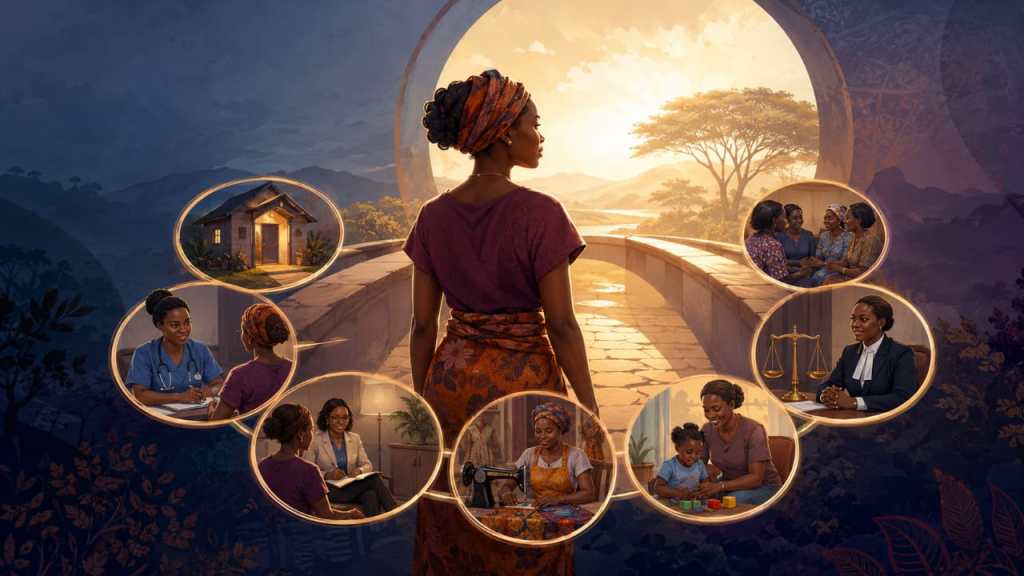
A woman facing abuse cannot rebuild her life on counselling alone. She may also need a safe home, an income, childcare, medical treatment—and institutions prepared to protect her.
Three recent publications on gender-based violence in Africa deliver one unmistakable message: surviving violence is not a single event. It is a difficult journey shaped by poverty, motherhood, conflict, weak public services and the availability—or absence—of practical support.
A “new study from Nairobi’s informal settlements” (https://link.springer.com/article/10.1007/s10896-026-01160-8) examined the experiences of mothers affected by intimate-partner violence. It found that many were battling psychological distress, financial insecurity, parenting pressures, inadequate housing and a lack of support from their children’s fathers.
Yet these women were not without agency. Trusted friends and the desire to protect their children became important sources of strength.
The lesson is simple but often ignored: telling a survivor to “just leave” is not a protection strategy. Where will she live? How will she feed her children? Who will care for them while she works? Can she access mental-health support without being blamed or exposed?
If those questions have no answers, society has not truly offered her a way out.
The situation is even more devastating in conflict zones. A “study of 375 survivors who reached seven treatment centres in Khartoum, Sudan” (https://obgyn.onlinelibrary.wiley.com/doi/10.1002/ijgo.71270) found that almost 45 per cent were children. Despite the collapse of much of the health system, locally established centres provided emergency contraception, HIV prevention medication, antibiotics and other essential care.
This is proof that local health workers and community organisations are not peripheral actors. In a crisis, they may be the last functioning line of protection. They need funding, medical supplies, security and international support—not applause after the emergency has passed.
An “August 24 briefing to the United Nations Security Council” (https://www.womenpeacesecurity.org/resource/un-security-council-briefing-sudan-eva-khair/) widened the picture. It linked sexual violence in Sudan to forced marriage, trafficking, domestic abuse, attacks on healthcare and the intimidation of those documenting violations.
For journalists, there is also a warning here. The people who reach hospitals, police stations or support centres represent only a portion of survivors. Recorded cases must never be casually presented as the full prevalence of GBV. Fear, stigma, displacement, destroyed services and threats of retaliation keep many survivors out of official statistics.
Responsible reporting must therefore move beyond shocking headlines and graphic descriptions. It should ask harder questions: Are shelters available? Are referral centres properly funded? Can survivors obtain medical care quickly? Are protection laws enforced? What happens to women and children after public attention moves to the next story?
Whether in Nairobi, Khartoum or Nigeria, sympathy is not enough. Awareness campaigns are not enough. Laws on paper are not enough.
Survivors need systems that work—and journalism must keep asking why so many of those systems still do not.

Leave a comment