
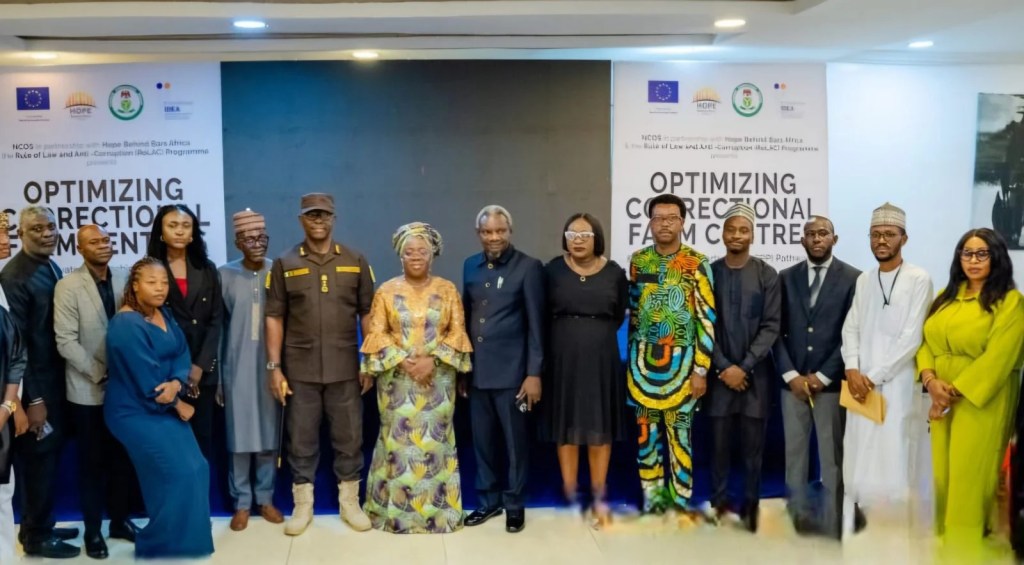
The Federal Government is ramping up calls for public-private partnerships to turn correctional centres into centres of skills, reform, and economic productivity.
The Federal Government has called for stronger Public-Private Partnerships (PPP) to drive lasting reforms across Nigeria’s correctional centres, with a focus on rehabilitation, skills development, and productivity.
Minister of Interior, Olubunmi Tunji-Ojo, made the call at a stakeholders’ dialogue in Abuja, stressing that transforming correctional facilities requires collective effort beyond government alone.
Represented by Permanent Secretary Magdalene Ajani, the minister said modern correctional systems must move beyond mere detention to becoming platforms for transformation and reintegration.
He praised Hope Behind Bars Africa (HBBA) for its work across custodial centres, noting that deeper collaboration with private sector players and civil society would accelerate reforms.
According to him, PPPs can help convert correctional farm centres into productive agricultural hubs—feeding inmates while equipping them with practical skills for life after release.
Controller-General of the Nigerian Correctional Service, Sylvester Nwakuche, said ongoing reforms are already repositioning facilities as centres of reformation.
He revealed that the service operates multiple farm centres, cottage industries, and agricultural projects nationwide—covering crops, poultry, fisheries, and livestock.
“PPP will boost productivity, modernise operations, and improve reintegration outcomes,” he said.
HBBA’s Executive Director, Funke Adeoye, highlighted the success of the “Farming Justice Project,” which combines agriculture with inmate rehabilitation to tackle food shortages and reduce reoffending.
She said the initiative—supported by the Rule of Law and Anti-Corruption Programme (ROLAC), the European Union, and International IDEA—has reached hundreds of inmates across facilities in Abuja, Lagos, and Edo.
Adeoye added that some centres are already generating income from farm produce, while inmates gain skills in agriculture, financial literacy, and behavioural reform.
Stakeholders at the event agreed that stronger partnerships, clear roles, and sustained investment are key to scaling reforms and building a correctional system that truly rehabilitates and empowers.

Leave a comment