
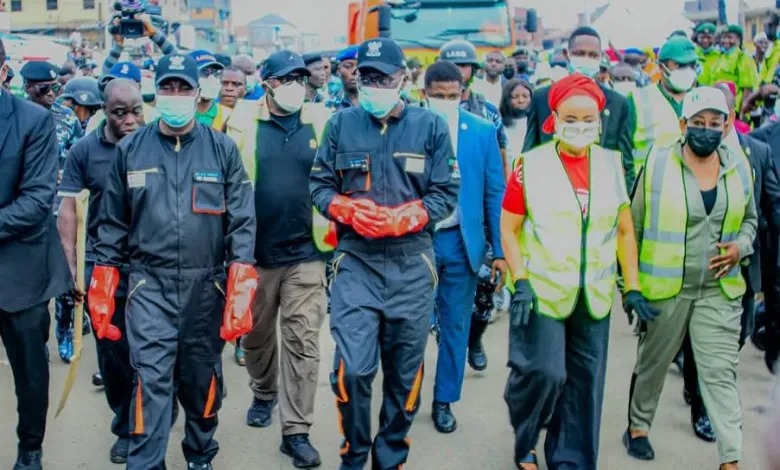
Lagos brings back a culture of community cleanliness — but this time without movement restrictions.
Governor Babajide Sanwo-Olu has announced the reintroduction of the monthly environmental sanitation exercise in Lagos, urging residents to actively participate in keeping the state clean and healthy.
Under the revived initiative, sanitation will now hold every last Saturday of the month from 6:30 a.m. to 8:30 a.m., encouraging residents to dedicate time to cleaning their homes, streets, markets and public spaces.
Speaking during a stakeholders’ engagement on environmental sanitation, Sanwo-Olu stressed that the initiative is not about politics but about public health and civic responsibility. According to him, a cleaner Lagos can only be achieved when citizens take ownership of their environment.
“A clean city is not achieved by government alone,” he said. “It is built every day by the actions of citizens in their homes, markets, communities and streets.”
The governor explained that the exercise aims to deepen environmental awareness and revive the culture of sanitation that once defined civic life across Nigeria.
Monthly environmental sanitation in Lagos was suspended in November 2016 following a ruling by the Federal High Court that declared the restriction of movement during the exercise unconstitutional. The decision led the administration of Akinwunmi Ambode to formally cancel the mandatory clean-up exercise.
Sanwo-Olu noted that while the court ruling ended movement restrictions, the responsibility of keeping the environment clean remains unchanged. The revived exercise will therefore focus on voluntary participation, awareness and community partnership rather than enforcement.
The governor also warned against indiscriminate dumping of waste into drainage channels, noting that plastics, sachet water bags and other refuse clog drains and worsen flooding, often causing roads to deteriorate even after repairs.
He called on Community Development Associations (CDAs), Community Development Committees (CDCs), market leaders, youths and religious organisations to take ownership of the initiative.
Earlier, the Commissioner for Environment and Water Resources, Tokunbo Wahab, described the decision as a bold step toward restoring Lagos’ long-standing culture of cleanliness.
Wahab revealed that the policy followed over a year of consultations with environmental stakeholders to ensure the sanitation exercise would be lawful, practical and widely supported.
He added that Lagos is also transitioning to a circular waste management system, where waste will be treated as a resource that can generate energy, fertiliser, compost and recyclable products, turning waste into economic value.
Other officials present at the event included Deputy Governor Obafemi Hamzat, Head of Service Bode Agoro and Chief of Staff Tayo Ayinde.

Leave a comment