
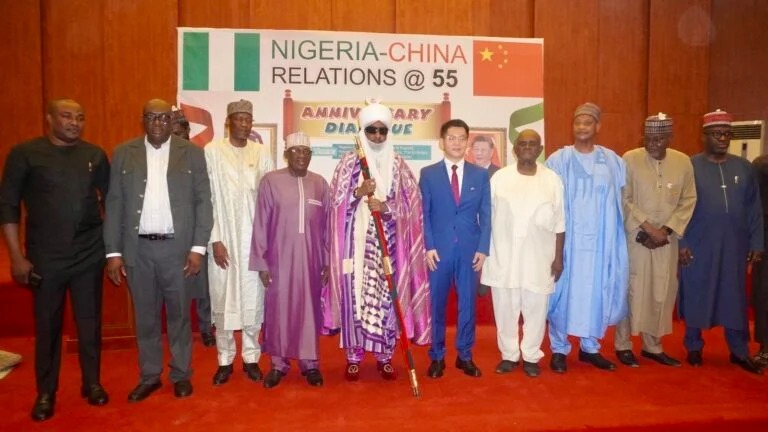
As both nations mark 55 years of diplomatic ties, leaders say the next phase must move beyond trade to real industrialisation and value addition.
Stakeholders in Abuja have called for a deeper, more strategic Nigeria–China partnership anchored on industrialisation, expanded market access and stronger Global South cooperation.
The call came at a high-level dialogue marking 55 years of diplomatic relations between Nigeria and China, established on Feb. 10, 1971.
Director of the Centre for China Studies (CCS), Charles Onunaiju, said the relationship began at a defining moment — Nigeria emerging from civil war and China reclaiming its UN seat. He recalled Nigeria’s support for China’s return to the United Nations in 1971 and reaffirmed that both countries have consistently backed each other’s sovereignty.
With bilateral trade exceeding $22 billion in 2025, Onunaiju said China’s shift from “workshop of the world” to “market of the world” offers fresh opportunities — especially with zero-tariff access for Nigerian goods.
Chinese Chargé d’Affaires, Zhou Hongyou, described both countries as trusted partners, noting that the relationship was upgraded to a Comprehensive Strategic Partnership in 2024. He highlighted major projects including the Lekki Deep Sea Port, Zungeru Hydropower Station and the Ajaokuta–Kaduna–Kano Gas Pipeline, while revealing that Chinese direct investment rose to $690 million — a 103% increase year-on-year.
Foreign Affairs Minister Yusuf Tuggar, represented by Amb. Muhammed Haidara, called zero-tariff access a “bridge to industrial strength,” but stressed that Nigeria must fix infrastructure, logistics and standards to fully benefit.
The Emir of Kano, Muhammadu Sanusi II, warned that Nigeria must avoid remaining a consumer nation. “Production and value addition must happen here,” he said, urging policymakers to strategically attract Chinese manufacturing investments.
As geopolitical tensions rise globally, speakers agreed that the next chapter of Nigeria–China relations must prioritise job creation, technology transfer and balanced trade.
At 55, the message was clear: the partnership must now deliver tangible industrial growth for Nigerians.

Leave a comment